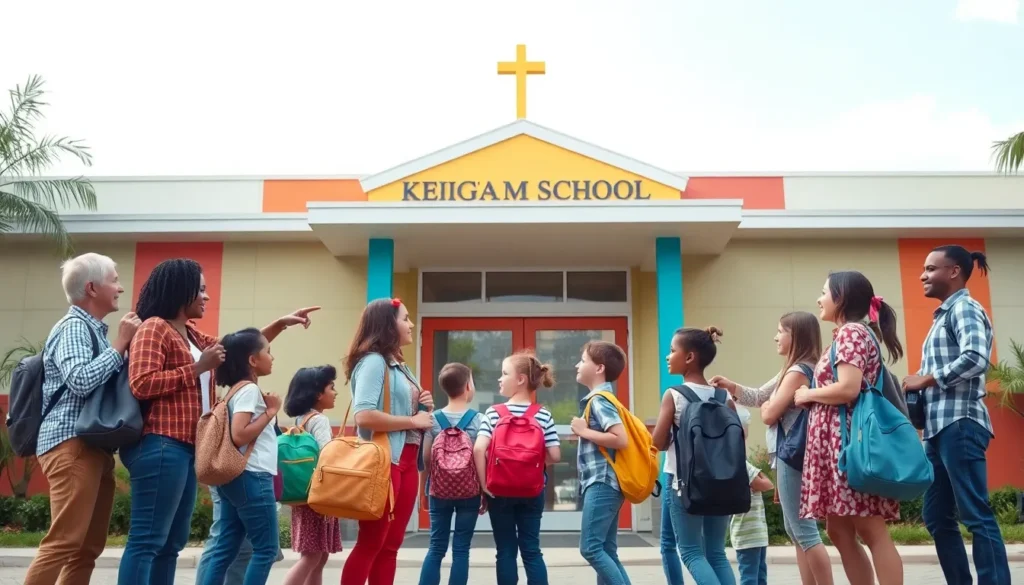
In a world where education meets faith, the debate over religious charter schools has reached the Supreme Court, and it’s shaping up to be a real doozy. Picture this: schools that blend academic rigor with spiritual teachings, all while navigating the tricky waters of the Constitution. It’s like trying to juggle flaming torches while riding a unicycle—exciting and a little scary!
Overview of Religious Charter Schools
Religious charter schools integrate academic instruction with religious teachings, creating a unique educational environment. Many states allow these schools to operate under charter school laws, providing them with public funding while maintaining specific educational standards. The appeal lies in their dual focus on academic achievement and spiritual development.
Some proponents argue that religious charter schools fulfill educational gaps by offering families variety in schooling options. Parents seeking faith-based education often find that these institutions address their values and beliefs effectively. The ability to provide a moral framework alongside academic rigor stands as a significant advantage.
Opponents raise concerns about the potential violation of the Establishment Clause in the First Amendment. Critics argue that public funding for religious institutions blurs the line between church and state. The legal landscape for these schools is ever-evolving as cases reach the Supreme Court, challenging existing precedents.
In various states, religious charter schools may face different regulatory requirements and funding mechanisms. For instance, some states impose limitations on religious content, while others permit a more extensive integration of faith in curricula. This disparity creates a landscape filled with complexities as each state grapples with its approach to religious charter education.
Ultimately, the discussion around religious charter schools reflects broader themes of educational choice and religious freedom. Attention remains focused on court decisions that could reshape the future of these educational institutions, influencing policy for years to come. The outcomes of these cases will determine the extent to which religious charter schools can operate within the framework of public education.
Legal Framework Surrounding Charter Schools
Charter schools operate within a complex legal framework that influences their formation, funding, and operational guidelines. Understanding the historical context and judicial involvement is crucial for grasping the current landscape.
History of Charter School Legislation
The charter school movement began in the early 1990s, with the first charter school law enacted in Minnesota. This law aimed to create educational alternatives by granting schools autonomy from traditional regulations while holding them accountable for student performance. By 2023, over 40 states and Washington, D.C., adopted charter school laws, reflecting a growing interest in educational choice. States vary in their approach, with some allowing for religious charter schools while others impose stricter limitations. As a result, the legislative history underscores the ongoing debate between educational innovation and regulatory oversight.
Supreme Court Involvement
Supreme Court cases involving charter schools often center around the Establishment Clause and school funding. Notable rulings have established precedents concerning the roles of public funds in religiously affiliated education. For instance, cases like Zelman v. Simmons-Harris (2002) have reinforced the notion that providing private school options, including religious schools, does not inherently violate the Constitution. Additionally, current cases may challenge the legality of public funding for religious charter schools, presenting new questions about the separation of church and state. These decisions shape the operational landscape of charter schools and may influence policies affecting religious education across the nation.
Key Supreme Court Cases
Several pivotal cases have shaped the legal landscape surrounding religious charter schools. These decisions impact the interpretation of the Establishment Clause and influence the relationship between public funding and religious education.
Case 1: Espinoza v. Montana Department of Revenue
Espinoza v. Montana Department of Revenue (2020) addressed whether Montana’s tax credit program violated the Constitution by excluding religious schools from receiving funding. The Supreme Court ruled unanimously that this exclusion constituted discrimination against religious institutions. The Court emphasized that states cannot inhibit families from accessing school choices based on their religious affiliations. This landmark decision reinforced the notion that public benefits cannot be denied simply due to a religious designation. Clarifying the broader implications, this case demonstrated heightened judicial protection for religious education access.
Case 2: Carson v. Makin
Carson v. Makin (2022) examined the state’s refusal to fund religious schools while providing funding for non-religious private schools. The Supreme Court determined that Maine’s policy unconstitutionally discriminated against religious organizations. Ensuring equal treatment, the ruling indicated that if states offer public funds for private education, they must include religious options. This decision further validated the argument that religious charter schools deserve the same funding opportunities as their secular counterparts. By reinforcing principles of educational choice, this ruling clarified the Court’s stance on religious inclusion in public funding initiatives.
Implications for Religious Charter Schools
Recent Supreme Court rulings significantly impact the trajectory of religious charter schools. The legal landscape is evolving as courts address religious affiliation and public funding.
Impact on Educational Choice
Increased access to religious charter schools enhances educational choices for families. Students can now attend schools that align with their faith and values. A broader range of options allows parents to select institutions that incorporate both academic excellence and spiritual education. As more states adopt favorable policies, the presence of religious charter schools expands, providing diverse learning environments. Data indicate that nearly 20% of charter schools in the U.S. express some religious affiliation. This growth reflects a demand for faith-based education options.
Separation of Church and State Concerns
Legal challenges arise regarding the intersection of government funding and religious education. Concerns center around possible violations of the Establishment Clause. Critics argue that public financing of religious charter schools blurs the line between church and state. Notably, the Supreme Court’s recent decisions imply a shift in how this separation is interpreted. Courts often emphasize that if a government program includes secular options, it cannot exclude religious ones. Outcomes from ongoing cases will further clarify what constitutes an appropriate balance, influencing future legislative approaches.
Future Considerations
Legal interpretations of religious charter schools continue to evolve. Recent Supreme Court rulings affect future policies and practices linked to public funding of religious education. Public benefits must include religious options when providing funding for private education. This requirement establishes a crucial precedent that may lead to increased accessibility for faith-based institutions.
Debate persists among educators, policymakers, and families regarding the implications of these rulings. Many parents now seek educational choices that align with their beliefs, prompting schools to adapt curricula accordingly. Over 20% of charter schools in the U.S. maintain some form of religious affiliation, demonstrating the increasing demand for such options.
Court decisions, like those in Espinoza and Carson, encourage lawmakers to reconsider funding structures. States may need to revise regulations that restrict financial support to religious charter schools. Families could benefit significantly from policies that promote educational equity without compromising constitutional principles.
Continued scrutiny of the Establishment Clause will influence future court cases. Legal experts predict that upcoming challenges will test the boundaries of religious involvement in publicly funded education. The landscape of religious charter schools stands on the brink of transformation, necessitating careful consideration of constitutional rights.
Ultimately, the balance between educational choice and religious freedom shapes ongoing discussions. Stakeholders must remain aware of shifting legal context, as it impacts both present and future educational opportunities.
The future of religious charter schools remains uncertain as legal interpretations evolve. Recent Supreme Court rulings are reshaping the landscape of public funding for religious education, highlighting the importance of balancing educational choice with constitutional rights. As families increasingly seek faith-based options, the demand for religious charter schools is likely to grow.
Ongoing legal challenges will continue to test the boundaries of church and state in education. Stakeholders must remain vigilant as new cases emerge, influencing policies and practices surrounding religious charter schools. The dialogue surrounding these institutions will play a crucial role in determining how educational options align with personal beliefs in the years to come.